21. LAN multiplayer 🔴
Two phones on the same Wi-Fi play each other with no server (net/). This chapter covers discovery, the socket
protocol, treating the network as hostile, and hiding addresses behind friendly names.
Architecture
sequenceDiagram
    participant H as Host
    participant J as Joiner
    H->>H: open ServerSocket(0), register NSD "_ttac._tcp"
    J->>J: discover "_ttac._tcp", resolve host & port
    J->>H: TCP connect
    H->>J: Hello(name, colour, boardSize, alias)
    J->>H: Hello(name, colour, 0, alias)
    loop each turn
        H-->>J: Move(round, index)
        J-->>H: Move(round, index)
    end
    H-->>J: Rematch(round) / Bye
Discovery with NSD
Android's Network Service Discovery (mDNS/DNS-SD) lets a phone advertise "I'm a TTac host on port N" without
anyone typing an address. The host registers _ttac._tcp with a service name TTac|<alias>|<player>; joiners browse
for that type, resolve each service to an address and port, and list it by alias. Resolves are queued through a
Channel, because older Android versions resolve one service at a time.
A line-delimited JSON protocol
Every message is one JSON object on one line, using kotlinx.serialization's sealed-class support:
@Serializable sealed interface LanMessage {
    @Serializable @SerialName("hello") data class Hello(val name: String, val color: Long, val boardSize: Int, val version: Int, val alias: String)
    @Serializable @SerialName("move") data class Move(val round: Int, val index: Int)
    @Serializable @SerialName("rematch") data class Rematch(val round: Int)
    @Serializable @SerialName("bye") data object Bye
}
Newlines make framing trivial: read until \n, decode one message.
Treat the network as hostile
- Bounded reads —
readBoundedLinerefuses lines over 2 KB, so a peer can't exhaust memory with an endless line. - Decode failures are ignored, not thrown.
- Every move is validated against round, turn, bounds and occupancy (see State machines).
- Version check in
Hellorejects incompatible builds.
Aliases, session codes and QR
Players never see IP addresses:
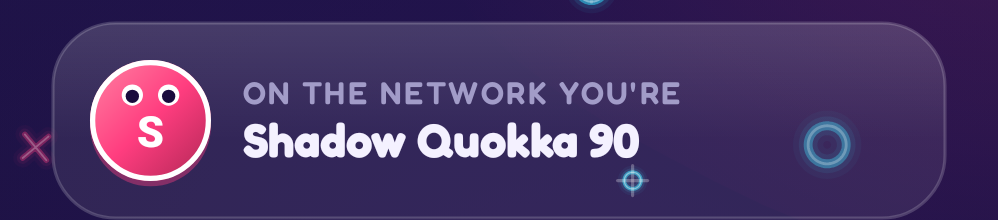
- Each phone gets a lasting random alias (adjective + animal + number, e.g. Velvet Badger 91) the first time it runs; history and streaks for LAN opponents are stored under their alias.
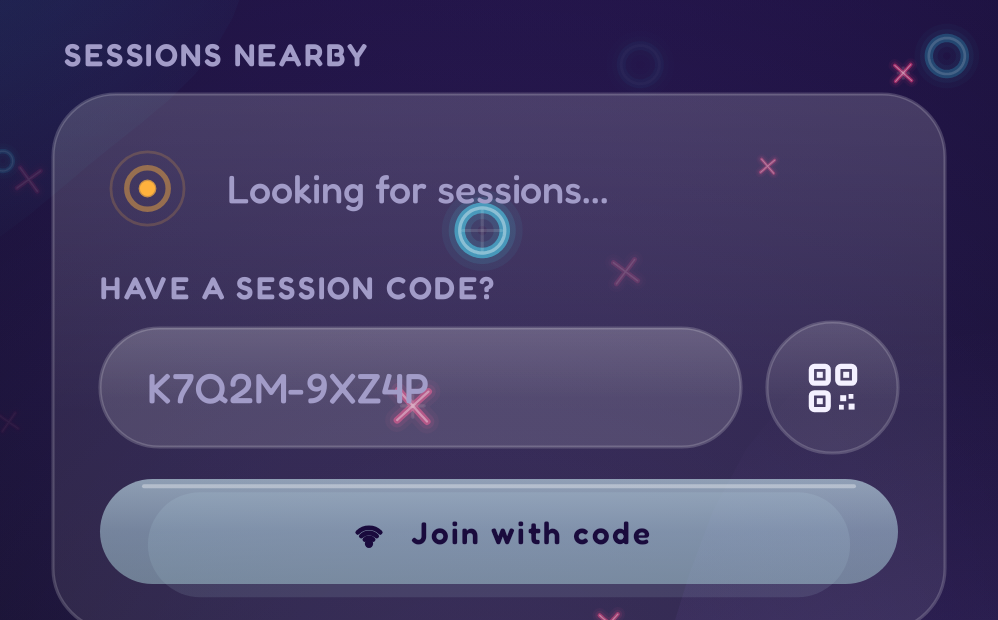
- A session code encodes the host's IPv4 address and port — 48 bits — as 10 Crockford base-32 characters
(
K7Q2M-9XZ4P). Crockford's alphabet drops I, L, O and U, and decoding maps look-alikes (O→0,I/L→1), so codes survive being read aloud. - A QR code carries
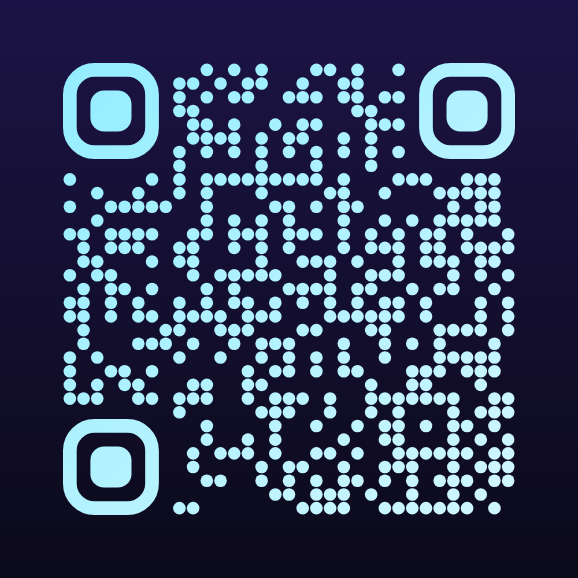
ttac://join?c=<code>&a=<alias>. It's drawn from the zxing bit matrix as rounded dots with soft finder eyes, with no backing card; on dark themes it's an inverted (light-on-dark) QR, which the in-app scanner decodes withALSO_INVERTED.
Going further
- The scanner uses CameraX
ImageAnalysiswithSTRATEGY_KEEP_ONLY_LATEST, decoding the Y (luminance) plane directly with zxing — no bitmap conversion. CHANGE_WIFI_MULTICAST_STATE+ aMulticastLockkeep mDNS packets flowing on devices that filter multicast.