14. Blocks — a falling-block engine 🟠
Blocks (game/Blocks.kt + ui/screens/BlocksScreen.kt) is an endless falling-block game: pieces fall, you move and
rotate them, full rows clear, and it speeds up until the stack reaches the top.

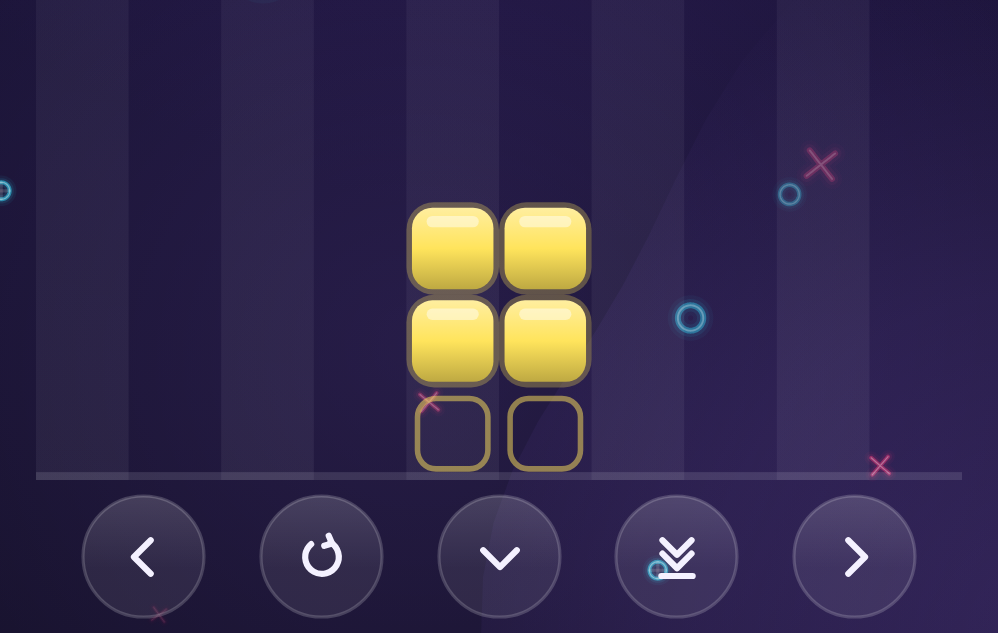
The capture above is a real run: the demo drops straight into play, and the first piece (a yellow O) is falling toward its ghost outline — the hollow squares at the floor show exactly where a hard drop would land it. Note the layout — the well sits directly on the animated backdrop, edge to edge, with a single HUD row (back · score · lines · level · next piece · pause) and a slim control strip.
Representing pieces
Each tetromino is a tiny ASCII grid, and rotations are computed, not typed out:
T(listOf(".X.", "XXX", "..."))

private val rotations by lazy {
    val base = rows.flatMapIndexed { y, row -> row.mapIndexedNotNull { x, c -> if (c == 'X') x to y else null } }
    generateSequence(base) { cells -> cells.map { (x, y) -> (box - 1 - y) to x } }.take(4).toList()
}
(x, y) → (box − 1 − y, x) rotates a cell 90° clockwise inside its bounding box (remember y points down). Applying
it four times returns to the start — a property the unit tests check for every piece. O never rotates.
The well
The well is a flat IntArray(width × height): 0 is empty, otherwise piece.ordinal + 1 (so the colour of settled
blocks is remembered). The active piece is not in the array; it's (piece, rot, px, py) and is drawn on top.
Collision is one function
fun fits(type: Tetromino, r: Int, x: Int, y: Int) = cellsOf(type, r, x, y).all { (cx, cy) ->
    cx in 0 until width && cy < height && (cy < 0 || grid[cy * width + cx] == 0)
}
Moving, rotating, falling and the ghost piece all ask one question: would the piece fit there? Cells above the top
(cy < 0) are allowed so pieces can spawn partly hidden.
Wall kicks
A rotation next to a wall or another block often collides. Instead of refusing, try nudging it:
for ((kx, ky) in listOf(0 to 0, -1 to 0, 1 to 0, -2 to 0, 2 to 0, 0 to -1)) {
    if (fits(piece, r, px + kx, py + ky)) { rot = r; px += kx; py += ky; return true }
}
Fair randomness: the 7-bag
Pure random pieces can deal four S pieces in a row. A bag shuffles all seven pieces and deals them before
reshuffling, so droughts are impossible and the next piece is always known (next is the head of the bag).
Locking and clearing
When a piece can't fall further it locks: its cells are written into the grid, full rows are found, and the
surviving rows are packed to the bottom with System.arraycopy. Scoring is 100 / 300 / 500 / 800 × level for 1–4
rows, plus 1 per soft-dropped row and 2 per hard-dropped row.
Endless play and speed
Runs never end on a goal — only when a new piece can't spawn. The difficulty sets the well and pace:
| Well | Start gravity | Win milestone | |
|---|---|---|---|
| Easy | 8 × 16 | 760 ms | 8 lines |
| Medium | 10 × 20 | 520 ms | 12 lines |
| Hard | 12 × 22 | 340 ms | 18 lines |
Level rises every 4 lines and gravity shrinks 12% per level: gravityMs = base × 0.88^(level−1). Passing the
milestone flags the run as a win (it counts toward unlocking Word Hive) and shows a toast, but play continues.
The game loop
LaunchedEffect(g, paused) {
    while (!g.over && !paused) {
        delay(g.gravityMs)
        g.tick()          // fall one row, or lock
        refresh()         // bump `frame` so the board redraws; detect clears for flash & sound
    }
}
The engine mutates plain fields, so the screen keeps a frame counter as the redraw signal.
Smooth motion over a grid
The engine lives on a grid, but the screen doesn't have to jump: the active piece's drawn position is two
Animatables that chase px/py — a stiff spring horizontally and a short tween vertically — and snap whenever a new
piece spawns (lockCount changed). The piece glides between cells while the rules stay exact.
Feel
- Ghost piece — outlined at
ghostY(), where a hard drop would land. - Line-clear flash — white bands where rows vanished, with sparks drifting outward.
- Thump — a hard drop springs the whole well down 6dp.
- Danger glow — red creeps down from the top when the stack is within five rows.
- Heat — the backdrop warms with level via
arcadeHeat, and the floor line heats toward the milestone.
Going further
BlocksTestincludes a greedy bot that evaluates every rotation and column (fewest holes, lowest stack) and plays until it passes the Easy milestone — an end-to-end test of the whole engine with no UI.- Real Tetris guidelines add SRS kick tables, lock delay and hold; the engine's
fits()design makes each a small addition.