16. Ludo Palace — rules, duels & multi-phone LAN 🟠
Ludo Palace (game/Ludo.kt, app/LudoController.kt, net/LudoNet.kt, ui/screens/LudoScreens.kt) is a 2–4
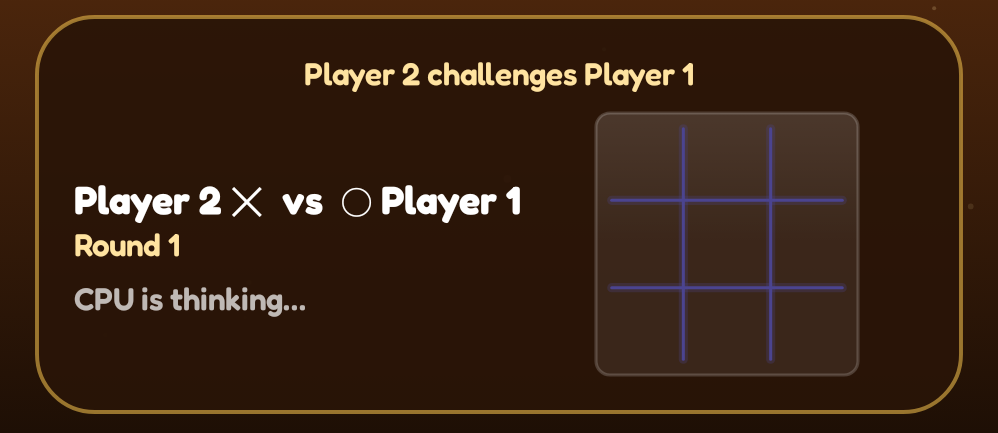
player board game where the dice are earned: on your turn you challenge anyone at the table to Tic-Tac-Toe, rounds
repeat until someone wins, and the winner rolls and moves.
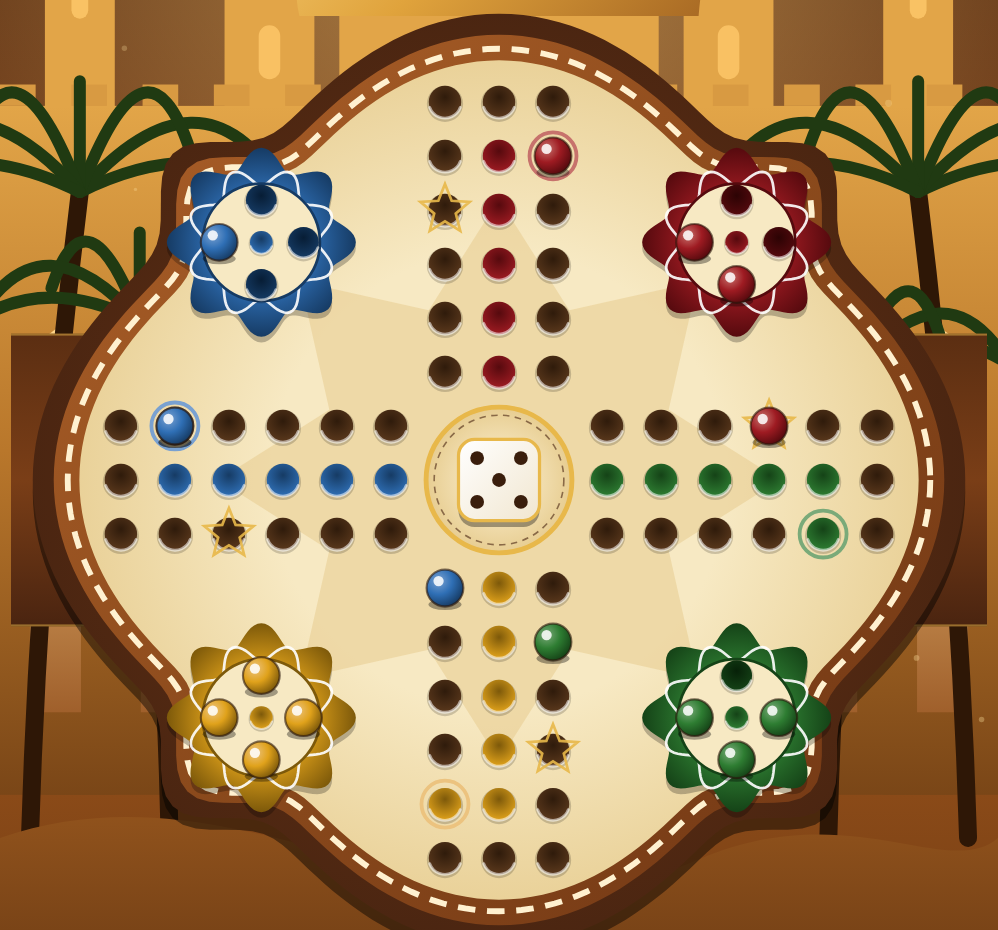

The board is a 15×15 grid
The classic Ludo cross fits a 15×15 grid: three-cell-wide arms, a 3×3 centre, and four 6×6 corner quadrants (where the rosette bases sit).
val loop: List<Pair<Int, Int>> = buildList {
    for (c in 0..5) add(c to 6)          // left arm, top row →
    for (r in 5 downTo 0) add(6 to r)    // top arm, left column ↑
    add(7 to 0)                          // top middle
    …                                    // clockwise around all four arms
    add(0 to 7)                          // left middle
}                                        // 6·8 + 4 = 52 squares
Two details matter:
- At the four inner corners the track steps diagonally —
(5,6)to(6,5)— exactly like a printed board. The unit test checks every step is a king's move, not a rook's. - Each colour starts 13 squares after the previous (
start = 1 + 13 × ordinal) and turns into its home lane from the square just before its start — the middle cell of its own arm.
A pawn's position is one number, its progress: −1 in base, 0…50 around the loop, 51…55 up its lane, 56
home. The loop square is (start + progress) % 52, so every colour runs the same arithmetic.
Rules as a reducer
| Phase | Who acts | Action |
|---|---|---|
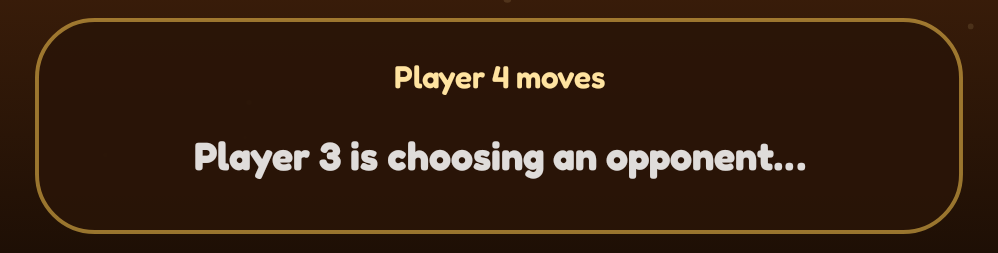
CHOOSE_OPPONENT |
the seat whose turn it is | Challenge(opponent) |
DUEL |
whichever duelist has the move | DuelMove(cell) |
ROLL |
the duel's winner | Roll |
MOVE |
the roller | MovePawn(i) |
- Leaving base needs a 6; getting home needs an exact roll.
- Landing on a rival on an unsafe square sends it back to base; starts and the square eight on from each start are safe.
- A 6 grants another roll straight away — no duel.
- Drawn duels replay with the marks swapped, so nobody keeps the ✕ advantage.
- The turn passes clockwise from the challenger, whoever won the duel.
Because apply returns null for anything illegal and every action names who's doing it (action.by), the same
function is the rule book and the anti-cheat check.
CPUs
LudoBot plays duels with the Tic-Tac-Toe AI at the table's difficulty, challenges the rival furthest ahead ("match
me" uses the same rule), and picks pawns by score: capture ≫ bring home ≫ leave base ≫ land on a safe square ≫
advance furthest. A unit test lets four CPUs play whole games to a winner.
Multi-phone LAN: the host is the authority
sequenceDiagram
    participant G as Guest phone
    participant H as Host phone
    G->>H: Join(name, alias)
    H->>G: Welcome(device = 2)
    H-->>G: Lobby(seats)          (G fills the first open LAN seat)
    H-->>G: State(v1)             (game starts)
    G->>H: Act(Challenge(RED, BLUE))
    H->>H: Ludo.apply(...) — legal? seat owned by device 2?
H-->>G: State(v2) (to every phone)- The host runs the only real copy of the game. Guests send intents (
Act); the host checks that the seat belongs to the sending device, applies the action with the reducer, and broadcasts the new state to everyone. - Every state carries a
version; guests ignore anything older than what they have. - Because every phone renders the same broadcast state, spectating is free — everyone sees the duel board update live.
- The same aliases, session codes, QR links and NSD discovery as two-player LAN (chapter 21),
with a separate service type (
_ttacludo._tcp) and up to three guests.
Drawing the board
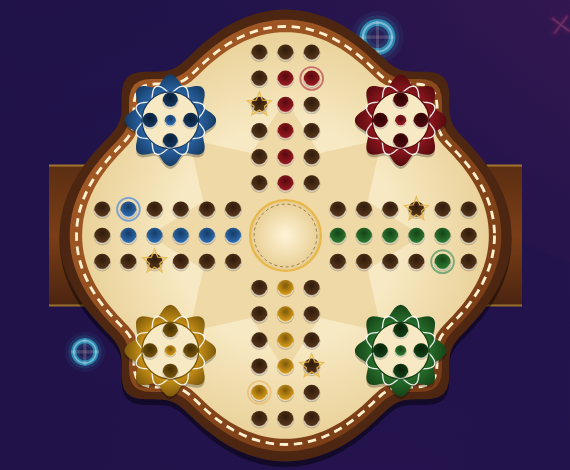
Modifier.ludoBoardBackground() draws the static board inside drawWithCache, so the frame, holes and rosettes are
built once and replayed — only pawns and the die redraw.
- The frame is one polar function:
r(θ) = R·(0.9 + 0.07·cos 4θ) + R·0.13·max(0, −cos 4θ)⁷. Thecos 4θterm swells four lobes on the axes; the seventh-power term adds sharp ogee tips on the diagonals. Drawn at four scales it gives the dark wood, copper band, dashed gold stitching and parchment. - Holes are carved: a drop shadow, a radial gradient darkest at the top, and a light arc on the lower lip.
- Rosettes are 8-petal flowers (
1 − d + d·(½ + ½·cos 8θ)) with a second, rotated petal ring in white. - Pawns hop: each pawn's shown progress is an
Animatablethat runs along the path at ~140 ms per square; the fractional part lifts it on a sine arc, and its shadow shrinks while it's airborne. - The die tumbles in with a spring from 540° when a roll lands.

The palace is painted procedurally — dusk gradient, sun glow, minarets with onion caps (two cubic Béziers each), crenellated walls with lit ogee arches, a great dome, palms (a curved trunk and seven quadratic fronds) and dunes — cached, with only the dust motes animating.