8. Living backdrops 🟡
The app never shows a flat background. AnimatedBackdrop (ui/draw/Decor.kt) layers a gradient, organic blobs,
drifting glows, a player tint and a starfield of ✕ and ◯ — all on one Canvas driven by a single 60-second clock.
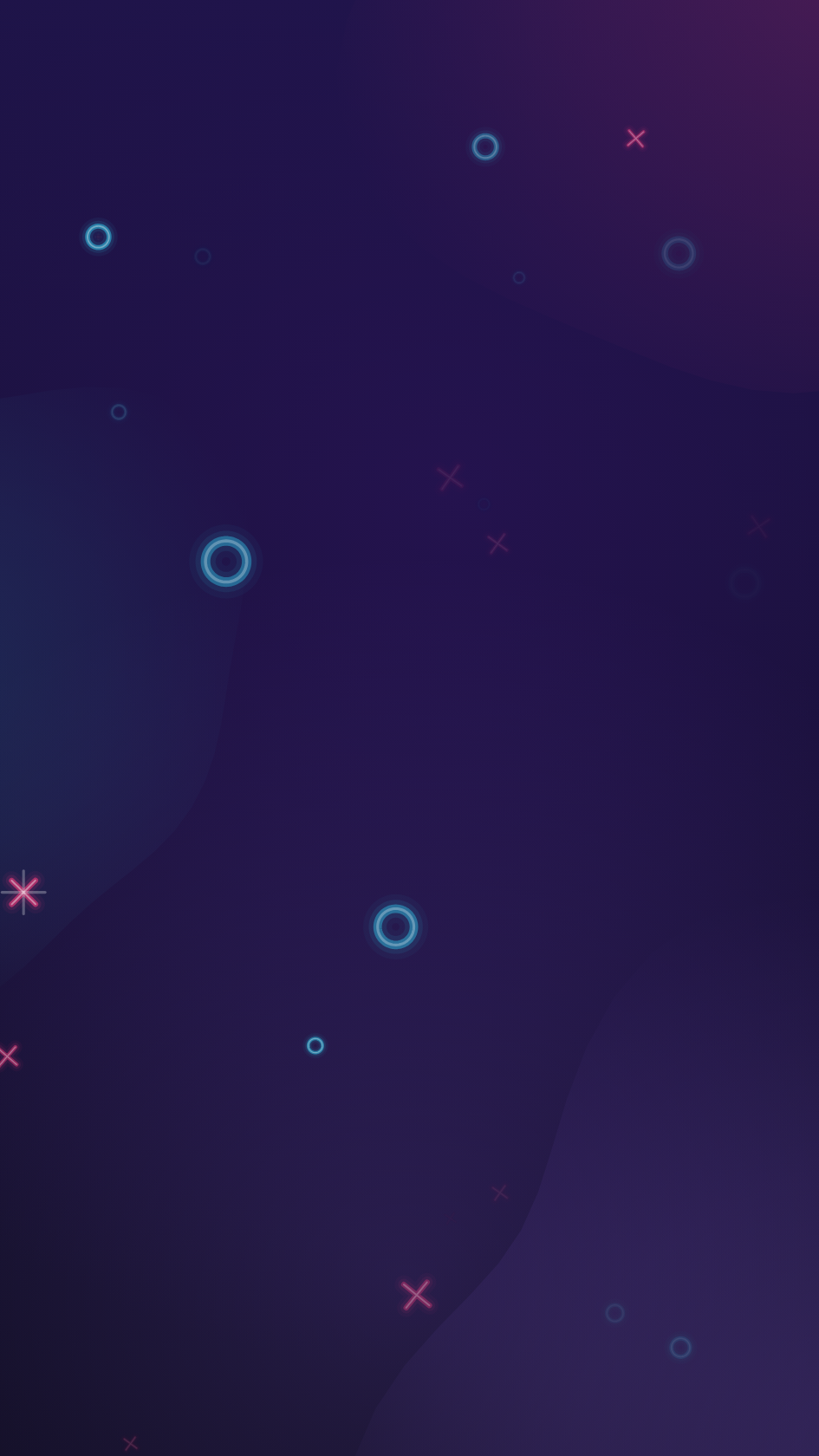
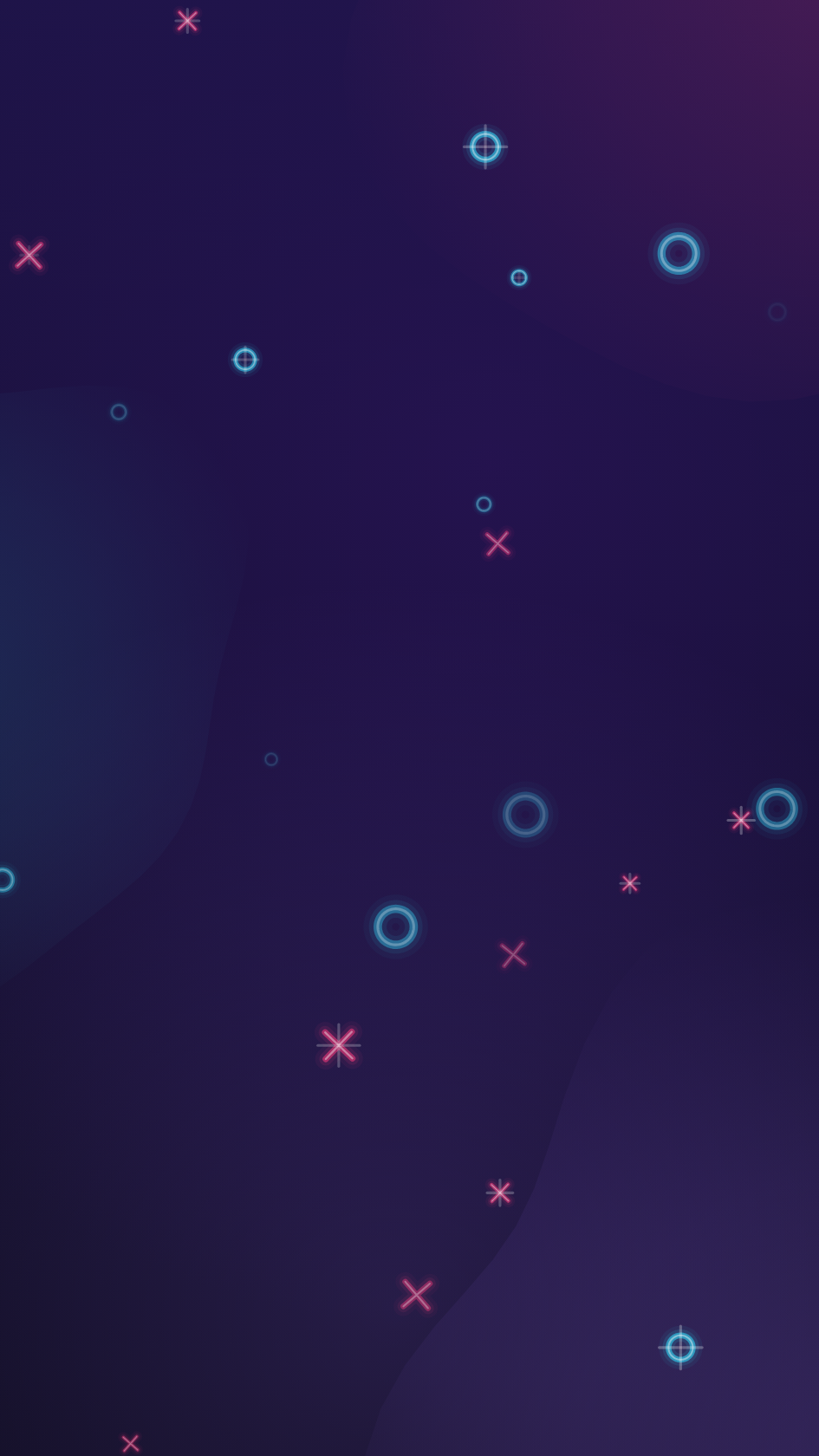
Compare the first two captures of the same backdrop two seconds apart: some stars have faded out, new ones have appeared elsewhere, and the blobs' edges have shifted.
One clock, many motions
val t by rememberInfiniteTransition().animateFloat(0f, 1f, infiniteRepeatable(tween(60_000, easing = LinearEasing)))
Everything derives from t: blob wobble phases, glow drift paths (sin(t·2π), cos(t·4π)), and star cycles. Using
integer multiples of 2π·t guarantees every motion is back where it started when t wraps from 1 to 0 — a seamless
loop.
Layers, back to front
- Vertical gradient from
bgToptobg. - Three blobs creeping in from the corners (pink top-right, cyan left, violet bottom-right).
- Player wash — a full-screen vertical gradient in the current player's colour (only during a game).
- Two drifting glows — large radial gradients; the main one swings toward the active player's side.
- The starfield.
Blobs: polar perturbation
A blob is a circle whose radius varies with angle θ:
Low frequencies (2, 3 and 5 bumps around the edge) with small amplitudes give an organic, not spiky, shape; the
phase φ moves with t, so the edge undulates slowly. The fill is a radial gradient that fades to transparent, so
blobs bleed softly into the background instead of showing an outline.
The LAN connection ripples use the same idea with stronger folds (up to 9%), a travelling phase and ease-out expansion, which is what makes them feel viscous and cloth-like.
The starfield
26 stars, each with a period (3, 4, 5, 6 or 10 s — all divide 60, so the loop stays seamless) and an offset. Each frame, for each star:
val cycleF = (seconds + s.offset * s.period) / s.period
val cycle = cycleF.toInt()                 // which appearance this is
val local = cycleF - cycle                 // 0..1 through this appearance
val glow = sin(π · local)²                 // fade in → peak → fade out
val rnd = Random(s.seed * 7919 + cycle * 104729)
val pos = Offset(width * rnd.nextFloat(), height * rnd.nextFloat())
sin²rises smoothly from 0, peaks in the middle and returns to 0 — the star appears and disappears with no pop.- The position is seeded by the cycle number, so it stays put while visible and moves somewhere new only while invisible.
- Size grows from 70% to 100% with the glow, and a tilt of ±12° swings across its life.
- At peak (
glow > 0.8) a white cross glint flashes.
The player tint
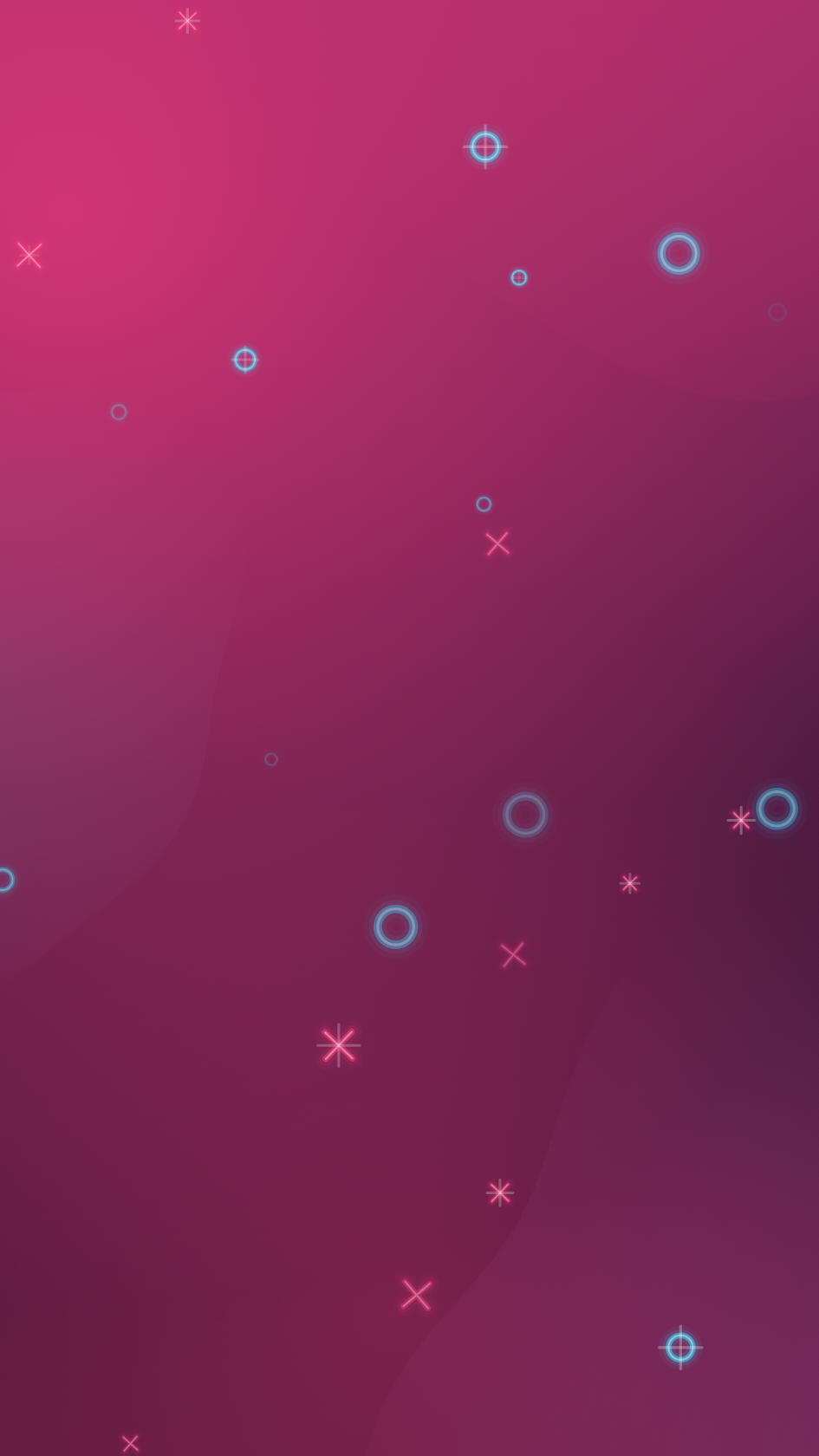
During a game, TTacApp passes tint (the current player's colour) and tintSide (−1 for ✕, +1 for ◯).
animateColorAsState and springs smooth both, so on every turn the whole screen washes toward the new colour and
the main glow swings to that player's side — see the pink-tinted capture above.
Going further
- All backdrop values are read inside the Canvas lambda → the backdrop never recomposes, only redraws.
- The backdrop sits behind the system bars (edge-to-edge), so there's no seam at the status bar.