7. Gradients, heat & particles 🟡
"Heat" is TTac's visual theme: winning lines burn, dangerous cells glow, and the heatmap shows where games get won. All of it comes from two ideas — gradient brushes and a colour ramp.
Brushes
A Brush paints with a gradient instead of a flat colour:
Brush.linearGradient(colors, start, end)        // along a line
Brush.verticalGradient(colors, startY, endY)     // top → bottom
Brush.horizontalGradient(colors)                  // left → right
Brush.radialGradient(colors, center, radius)     // outward from a point
Colour stops control where each colour sits along the gradient (0 = start, 1 = end):
Brush.radialGradient(
    0f to heat(1f).copy(alpha = 0.55f),     // white-yellow hot core
    0.35f to heat(0.75f).copy(alpha = 0.45f), // orange
    0.7f to heat(0.35f).copy(alpha = 0.22f),  // magenta
    1f to Color.Transparent,                 // no hard edge
    center = c, radius = r,
)
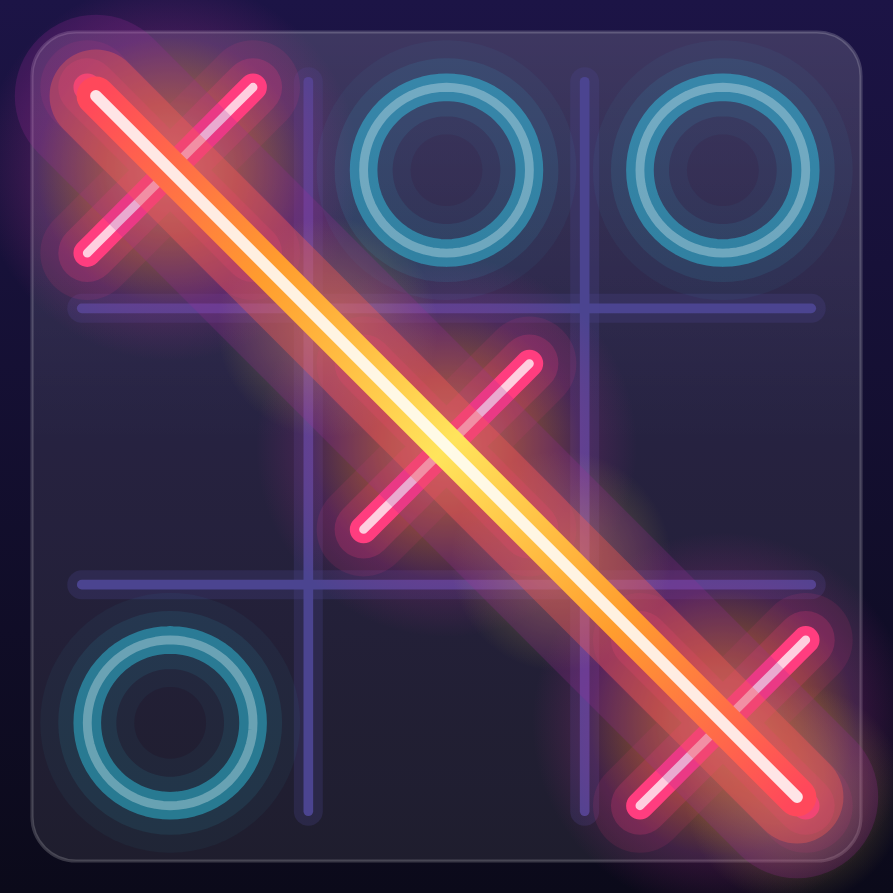
That's the brush for each win "heat zone" — the soft glows sitting under the three winning ✕s here:
The heat ramp
Palette.heat is five colours from cold to hot: deep indigo → violet → hot pink → orange → yellow (the light theme
has a paler ramp that reads on paper). heatAt(t) samples it anywhere between 0 and 1:
fun Palette.heatAt(t: Float): Color {
    val x = t.coerceIn(0f, 1f) * (heat.size - 1)   // 0..4
    val i = x.toInt().coerceAtMost(heat.size - 2)    // left stop
    return lerp(heat[i], heat[i + 1], x - i)         // blend to the right stop
}
Every heat effect in the app — the win line, zones, heatmap, streak meters, Blocks' speed tint — calls heatAt, so
"hot" always means the same colour. The light theme has its own ramp, tuned to read on paper.
Win heat, step by step
// Zones ignite one after another as the stroke passes over them.
val local = ((progress * (cells.size + 1)) - k).coerceIn(0f, 1f)
val r = cell * (0.62f + 0.07f * pulse) * local
progressruns 0 → 1; each winning cellkgets its own local 0 → 1 slice, so zones light up in sequence.pulse(an infinite 0 ↔ 1) breathes the radius by ±7%.- Three "hot spots" flow along the line: positions at
(flow + k/3) % 1along the stroke, drawn as small radial glows. - The stroke itself is four
drawLines — wide faint, medium, a linear gradient from the heat ramp, and a thin white core. Exactly the neon trick from chapter 4, with a gradient.
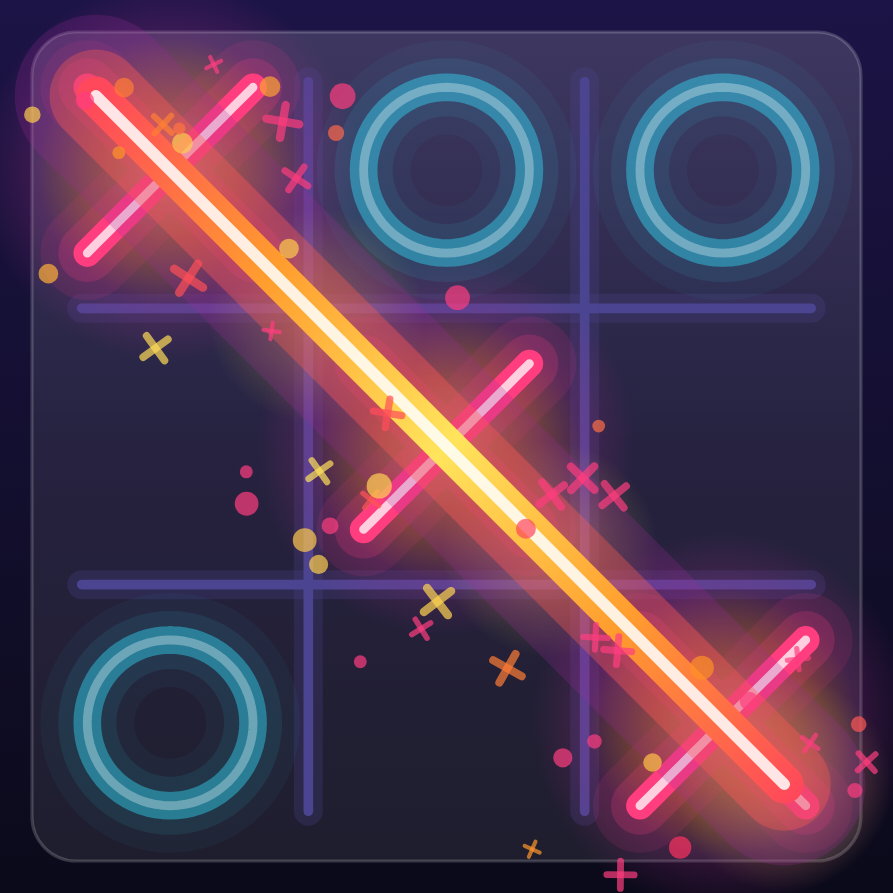
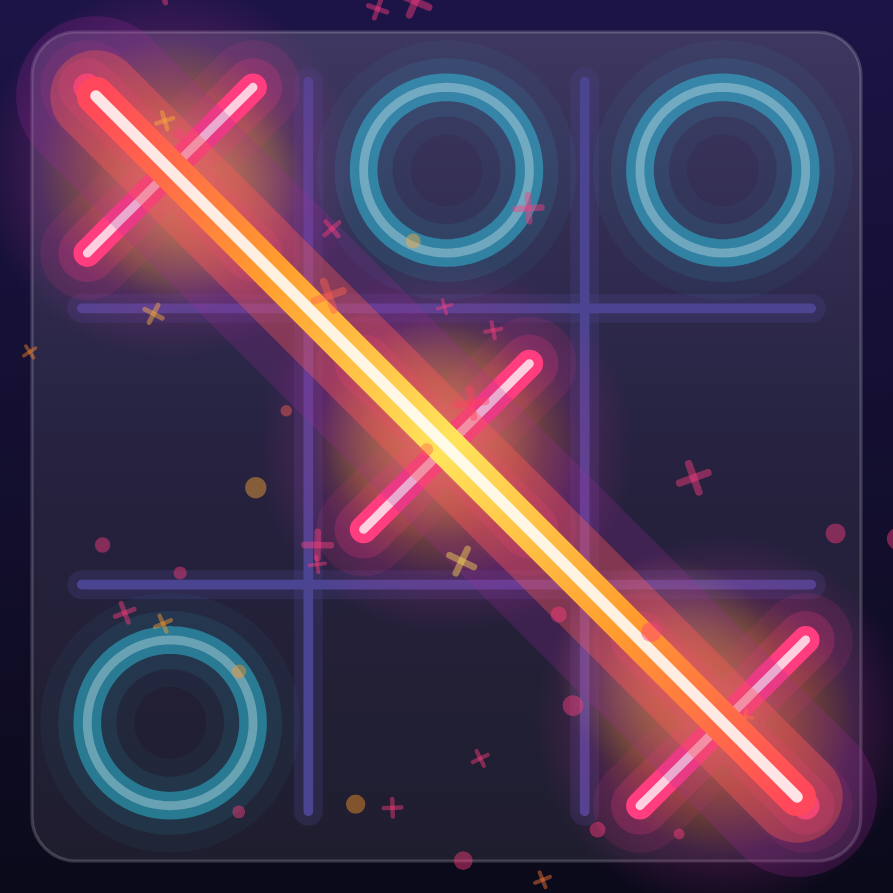
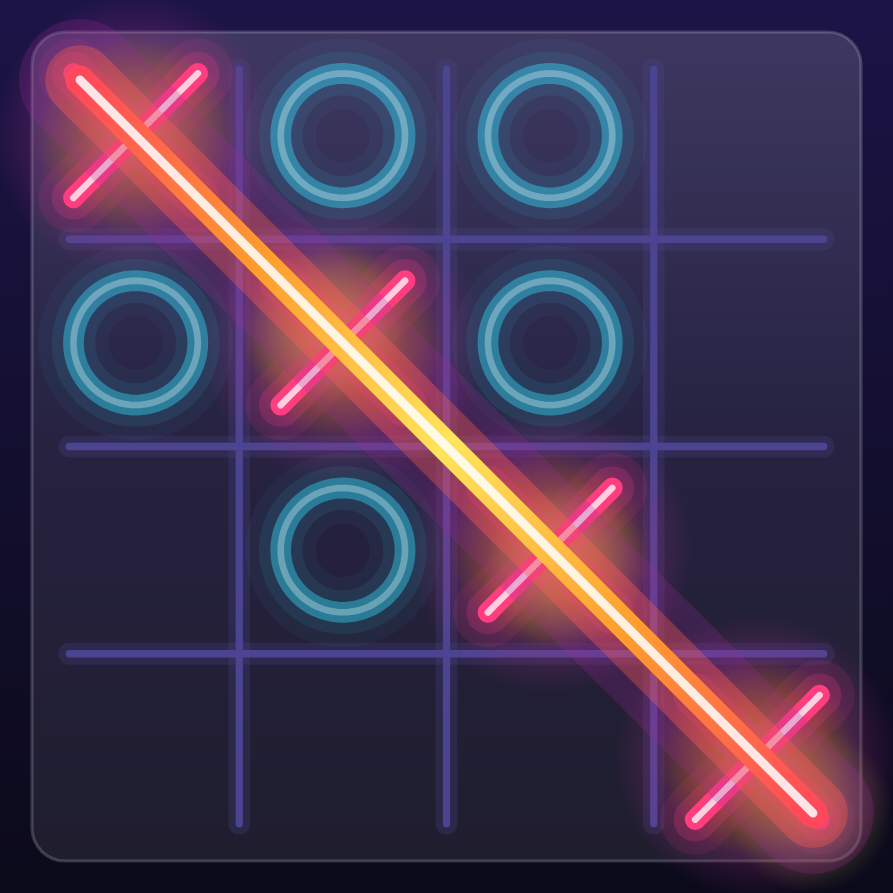
At 820 ms the stroke is still travelling and only the zones it has passed have lit; at 1250 ms the particle burst is mid-flight. The same code handles longer lines on bigger boards.
Threat heat
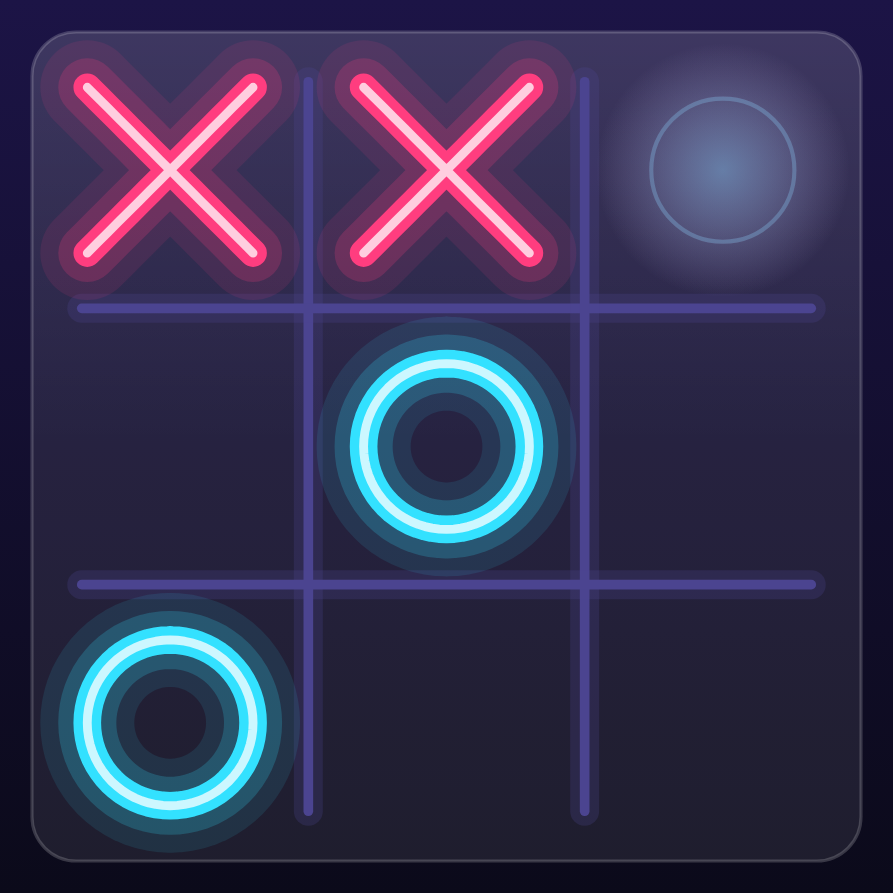
Board.threats(mark) returns empty cells that would complete a line. Each gets a radial glow in that player's
colour plus a thin ring that shrinks as the glow swells — a pulse you notice peripherally without it shouting.
The heatmap: felt, not read
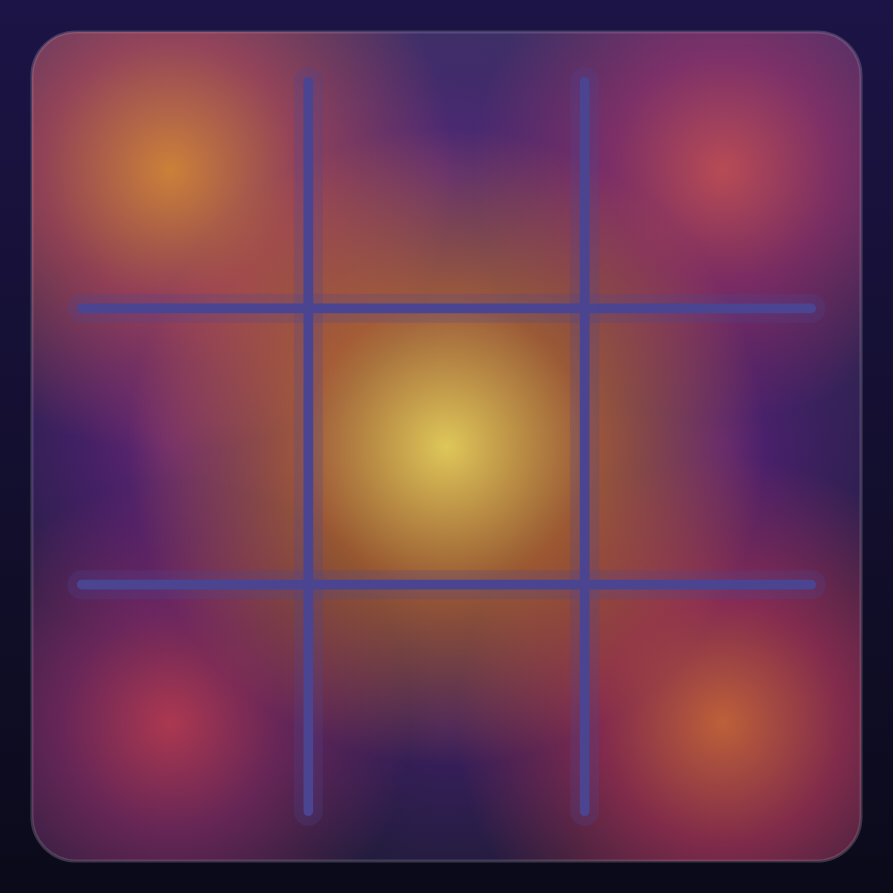
Early versions printed percentages in each cell. The current version draws a thermal field:
- Clip to the board's rounded rectangle.
- Wash the whole board in the coldest ramp colour.
- Draw one radial glow per cell, sized
0.55 + 0.55 × vcells and colouredheatAt(v), coolest first so hot glows sit on top. - Hot cells "breathe": radius ×
(1 + 0.1 · v · pulse).
Overlapping glows blend into a continuous field, like a thermal camera image.
Particles without state
56 particles, zero particle objects. Each frame:
val rnd = Random(particleSeed)          // same seed every frame → same particles
repeat(56) {
    val from = centerOf(win.cells[rnd.nextInt(win.cells.size)])
    val angle = rnd.nextFloat() * 2π
    val speed = cell * (0.8f + rnd.nextFloat() * 1.8f)
    val pos = from + (cos(angle), sin(angle)) * speed * b + (0, gravity * b²)
    …draw a dot or a spinning mini-✕, alpha = 1 - b…
}
Replaying a seeded Random regenerates identical properties every frame, and position is a closed-form function of
burst progress b. There's nothing to update, allocate or leak.
Going further
- For hundreds of particles you'd precompute them once into arrays (
remember(seed)) to skip RNG work per frame. - Radial gradients with transparent edges are cheap "soft circles"; stacking 3–4 gives convincing bloom without a
blur pass (blur via
RenderEffectneeds API 31 and costs a render pass).